Next Generation Learning & Skills category
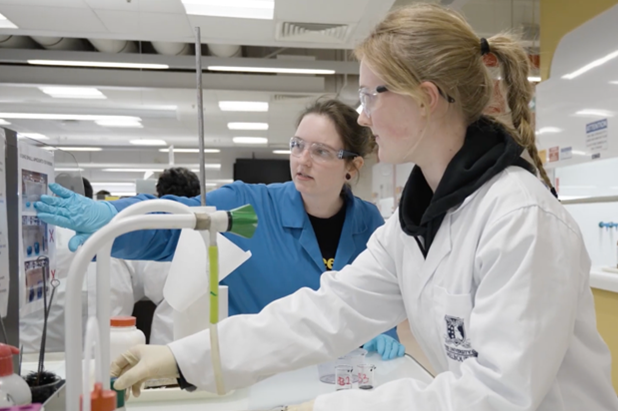
The University of Melbourne’s Undergraduate Chemistry Practical Subject Rejuvenation has transformed first-year laboratory education by embedding sustainability into both curriculum and laboratory practice. Reaching more than 3,000 students annually, the initiative ensures future scientists learn to consider environmental impact, resource use, waste management and safer chemical practices alongside scientific technique and experimental outcomes.
The project redesigned the practical chemistry program to include sustainability as an explicit learning outcome, with each experiment incorporating a defined sustainability takeaway. Students now learn in laboratories that model best practice through reusable materials, optimised reaction scales, improved waste systems, sustainable procurement and safer chemical substitutions.
The initiative has delivered measurable operational outcomes, including a 50% reduction in hazardous waste, a 93% reduction in snap lock bag use, reuse of approximately 4,000 pipette tips annually, and diversion of 400kg of gloves from landfill each year. In 2025, the first-year chemistry teaching laboratory achieved My Green Lab Green Level certification, demonstrating how sustainability can be embedded into core science education at scale.

Top 3 learnings
Supported by

Category finalists
Next Generation Learning & Skills
Next Generation Learning & Skills

Next Generation Learning & Skills
Next Generation Learning & Skills

Next Generation Learning & Skills
Next Generation Learning & Skills
Next Generation Learning & Skills
Next Generation Learning & Skills
Next Generation Learning & Skills category
The University of Melbourne’s Undergraduate Chemistry Practical Subject Rejuvenation has transformed first-year laboratory education by embedding sustainability into both curriculum and laboratory practice. Reaching more than 3,000 students annually, the initiative ensures future scientists learn to consider environmental impact, resource use, waste management and safer chemical practices alongside scientific technique and experimental outcomes.
The project redesigned the practical chemistry program to include sustainability as an explicit learning outcome, with each experiment incorporating a defined sustainability takeaway. Students now learn in laboratories that model best practice through reusable materials, optimised reaction scales, improved waste systems, sustainable procurement and safer chemical substitutions.
The initiative has delivered measurable operational outcomes, including a 50% reduction in hazardous waste, a 93% reduction in snap lock bag use, reuse of approximately 4,000 pipette tips annually, and diversion of 400kg of gloves from landfill each year. In 2025, the first-year chemistry teaching laboratory achieved My Green Lab Green Level certification, demonstrating how sustainability can be embedded into core science education at scale.
Top 3 learnings
Supported by
Category finalists
Next Generation Learning & Skills
Next Generation Learning & Skills
Next Generation Learning & Skills
Next Generation Learning & Skills
Next Generation Learning & Skills
Next Generation Learning & Skills
Next Generation Learning & Skills
Next Generation Learning & Skills