Next Generation Learning & Skills category
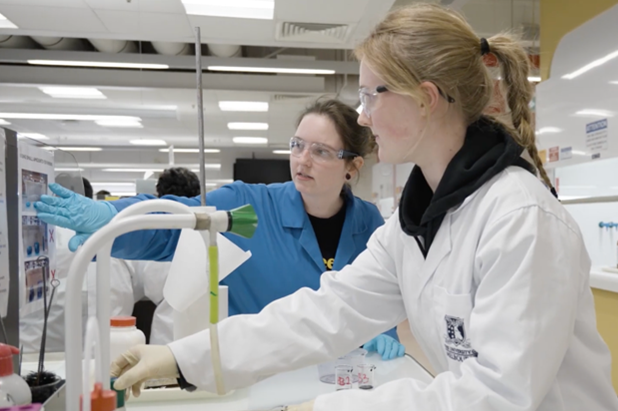
The University of Melbourne’s Undergraduate Chemistry Practical Subject Rejuvenation has transformed first-year laboratory education by embedding sustainability into both curriculum and laboratory practice. Reaching more than 3,000 students annually, the initiative ensures future scientists learn to consider environmental impact, resource use, waste management and safer chemical practices alongside scientific technique and experimental outcomes.
The project redesigned the practical chemistry program to include sustainability as an explicit learning outcome, with each experiment incorporating a defined sustainability takeaway. Students now learn in laboratories that model best practice through reusable materials, optimised reaction scales, improved waste systems, sustainable procurement and safer chemical substitutions.
The initiative has delivered measurable operational outcomes, including a 50% reduction in hazardous waste, a 93% reduction in snap lock bag use, reuse of approximately 4,000 pipette tips annually, and diversion of 400kg of gloves from landfill each year. In 2025, the first-year chemistry teaching laboratory achieved My Green Lab Green Level certification, demonstrating how sustainability can be embedded into core science education at scale.
Impacts & Benefits
- Reaches more than 3,000 first-year students annually, embedding sustainability into foundational chemistry laboratory education.
- Reduced hazardous waste by approximately 50%, from around 1,700L to 900L per semester.
- Cut single-use plastics significantly, including a 93% reduction in snap lock bag use and replacement of thousands of plastic pipettes with reusable glass pipettes.
- Diverted 400kg of gloves from landfill each year, alongside reuse of pipette tips, TLC spotters, boiling chips and other materials.
- Achieved My Green Lab Green Level certification, externally validating the laboratory’s sustainable operations and teaching practices.
Leadership & Engagement
- Embedded sustainability as a core scientific competency, making Green Chemistry and responsible resource use part of everyday laboratory learning.
- Aligned curriculum, operations and staff capability, ensuring students learn sustainability through both formal teaching and lived laboratory practice.
- Engaged a broad teaching community, including six teaching staff, four professional staff and around 70–80 sessional demonstrators.
- Developed practical guidelines and induction processes, supporting consistent implementation of safe, efficient and sustainable laboratory practices.
- Created a scalable model for other laboratories, with protocols, standard operating procedures and low-cost initiatives that can be adapted across teaching and research settings.
Wider Societal Impact
- Prepared future scientists for sustainable practice, equipping students with habits and expectations they can carry into research, industry and professional laboratories.
- Normalised sustainability in scientific education, treating environmental responsibility as part of good laboratory practice rather than an optional extra.
- Reduced the environmental footprint of high-volume teaching, showing how small changes can produce meaningful cumulative impact at scale.
- Strengthened institutional culture change, engaging staff, students, procurement, facilities and safety teams in shared sustainability action.
- Provided a transferable example for other sectors, with relevance to healthcare, research, manufacturing, government services and other laboratory-intensive settings.

Top 3 learnings
Supported by
Category finalists
Next Generation Learning & Skills
Next Generation Learning & Skills

Next Generation Learning & Skills
Next Generation Learning & Skills

Next Generation Learning & Skills
Next Generation Learning & Skills
Next Generation Learning & Skills
Next Generation Learning & Skills
Next Generation Learning & Skills category
The University of Melbourne’s Undergraduate Chemistry Practical Subject Rejuvenation has transformed first-year laboratory education by embedding sustainability into both curriculum and laboratory practice. Reaching more than 3,000 students annually, the initiative ensures future scientists learn to consider environmental impact, resource use, waste management and safer chemical practices alongside scientific technique and experimental outcomes.
The project redesigned the practical chemistry program to include sustainability as an explicit learning outcome, with each experiment incorporating a defined sustainability takeaway. Students now learn in laboratories that model best practice through reusable materials, optimised reaction scales, improved waste systems, sustainable procurement and safer chemical substitutions.
The initiative has delivered measurable operational outcomes, including a 50% reduction in hazardous waste, a 93% reduction in snap lock bag use, reuse of approximately 4,000 pipette tips annually, and diversion of 400kg of gloves from landfill each year. In 2025, the first-year chemistry teaching laboratory achieved My Green Lab Green Level certification, demonstrating how sustainability can be embedded into core science education at scale.
Top 3 learnings
Impacts & Benefits
- Reaches more than 3,000 first-year students annually, embedding sustainability into foundational chemistry laboratory education.
- Reduced hazardous waste by approximately 50%, from around 1,700L to 900L per semester.
- Cut single-use plastics significantly, including a 93% reduction in snap lock bag use and replacement of thousands of plastic pipettes with reusable glass pipettes.
- Diverted 400kg of gloves from landfill each year, alongside reuse of pipette tips, TLC spotters, boiling chips and other materials.
- Achieved My Green Lab Green Level certification, externally validating the laboratory’s sustainable operations and teaching practices.
Leadership & Engagement
- Embedded sustainability as a core scientific competency, making Green Chemistry and responsible resource use part of everyday laboratory learning.
- Aligned curriculum, operations and staff capability, ensuring students learn sustainability through both formal teaching and lived laboratory practice.
- Engaged a broad teaching community, including six teaching staff, four professional staff and around 70–80 sessional demonstrators.
- Developed practical guidelines and induction processes, supporting consistent implementation of safe, efficient and sustainable laboratory practices.
- Created a scalable model for other laboratories, with protocols, standard operating procedures and low-cost initiatives that can be adapted across teaching and research settings.
Wider Societal Impact
- Prepared future scientists for sustainable practice, equipping students with habits and expectations they can carry into research, industry and professional laboratories.
- Normalised sustainability in scientific education, treating environmental responsibility as part of good laboratory practice rather than an optional extra.
- Reduced the environmental footprint of high-volume teaching, showing how small changes can produce meaningful cumulative impact at scale.
- Strengthened institutional culture change, engaging staff, students, procurement, facilities and safety teams in shared sustainability action.
- Provided a transferable example for other sectors, with relevance to healthcare, research, manufacturing, government services and other laboratory-intensive settings.
Supported by
Category finalists
Next Generation Learning & Skills
Next Generation Learning & Skills
Next Generation Learning & Skills
Next Generation Learning & Skills
Next Generation Learning & Skills
Next Generation Learning & Skills
Next Generation Learning & Skills
Next Generation Learning & Skills