Powerful Partnerships category
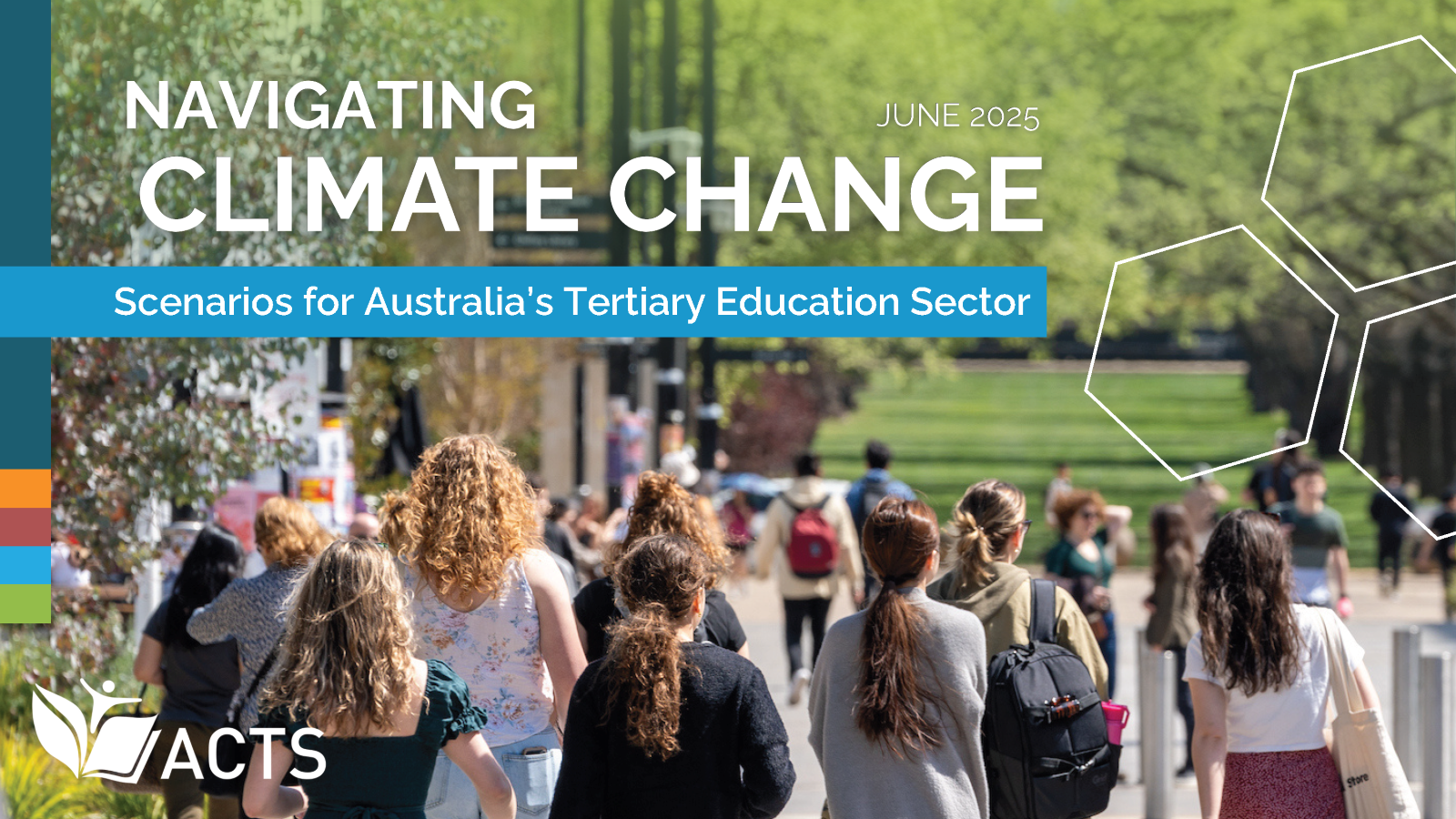
The Climate Scenarios Working Group brought together twelve Australian universities through the ACTS network to create the Australian tertiary education sector’s first shared climate scenario framework. Inspired by earlier work in Aotearoa New Zealand, the partnership recognised that climate change presents shared, systemic risks that are better addressed through collective action than isolated institutional efforts.
Through a nationally coordinated, co-designed process involving more than 150 stakeholders across the twelve Working Group universities and other tertiary education sector institutions, the group developed four climate scenarios for Australia’s tertiary education sector, aligned with Intergovernmental Panel on Climate Change (IPCC) pathways and emerging climate disclosure requirements. The process brought together sustainability leaders, academic and professional staff, students, governance representatives and external stakeholders to explore implications for teaching, research, operations, infrastructure, student experience and institutional strategy.
By pooling funding, expertise and delivery capacity, the partnership avoided duplication, reduced costs and created a publicly available framework now being used to inform climate risk assessments, strategic planning and sustainability reporting. The collaboration has since evolved into an expanded Climate Risk and Adaptation Group, demonstrating lasting sector value.
Impacts & Benefits
- Created the first shared Australian tertiary education sector climate scenarios framework, supporting sector-wide climate risk planning, adaptation and reporting.
- Engaged more than 150 stakeholders through workshops involving students, academic and professional staff from tertiary education institutions, as well as subject matter experts and external stakeholders.
- Reduced duplication and cost, replacing twelve separate institutional processes with one shared, high-quality framework.
- Built climate literacy and capability, helping institutions better understand physical and transition risks across teaching, research, operations and communities.
- Achieved strong sector uptake, with the report downloaded 746 times within 12 months.
Leadership & Engagement
- Demonstrated sector-wide collaborative leadership, with participating universities contributing funding, staff time, expertise and shared ownership.
- Used ACTS as a trusted convening platform, enabling coordination across institutions and supporting broader sector participation.
- Established a distributed leadership model, including three co-chairs from different institutions and 17 working group members across 12 universities.
- Prioritised collective impact over competition, creating a publicly available resource to benefit the whole tertiary education sector.
- Created an ongoing peer-support network, with the partnership evolving into a Climate Risk and Adaptation Group to sustain collaboration.
Wider Societal Impact
- Strengthened the tertiary education sector’s leadership role in climate resilience, helping universities prepare to educate future leaders, support communities and inform public decision-making.
- Supported proactive climate risk disclosure and planning, helping institutions respond to emerging reporting requirements before they apply broadly.
- Created a transferable model for other sectors, as initially identified by representatives from the Australian Accounting Standards Board (AASB), with the methodology already adapted by the Tasmanian Policy Exchange for Government-Related Entities.
- Encouraged more integrated climate decision-making, linking climate risk with finance, governance, infrastructure, strategy, student recruitment and community impact.
- Demonstrated the power of collaboration at scale, showing how shared tools, funding and expertise can accelerate climate adaptation beyond individual institutional capacity.


Top 3 learnings
Supported by

Category finalists
Powerful Partnerships
Powerful Partnerships
Powerful Partnerships
Powerful Partnerships
Powerful Partnerships
Powerful Partnerships
Powerful Partnerships
Powerful Partnerships
Powerful Partnerships
Powerful Partnerships
Powerful Partnerships category
The Climate Scenarios Working Group brought together twelve Australian universities through the ACTS network to create the Australian tertiary education sector’s first shared climate scenario framework. Inspired by earlier work in Aotearoa New Zealand, the partnership recognised that climate change presents shared, systemic risks that are better addressed through collective action than isolated institutional efforts.
Through a nationally coordinated, co-designed process involving more than 150 stakeholders across the twelve Working Group universities and other tertiary education sector institutions, the group developed four climate scenarios for Australia’s tertiary education sector, aligned with Intergovernmental Panel on Climate Change (IPCC) pathways and emerging climate disclosure requirements. The process brought together sustainability leaders, academic and professional staff, students, governance representatives and external stakeholders to explore implications for teaching, research, operations, infrastructure, student experience and institutional strategy.
By pooling funding, expertise and delivery capacity, the partnership avoided duplication, reduced costs and created a publicly available framework now being used to inform climate risk assessments, strategic planning and sustainability reporting. The collaboration has since evolved into an expanded Climate Risk and Adaptation Group, demonstrating lasting sector value.
Top 3 learnings
Impacts & Benefits
- Created the first shared Australian tertiary education sector climate scenarios framework, supporting sector-wide climate risk planning, adaptation and reporting.
- Engaged more than 150 stakeholders through workshops involving students, academic and professional staff from tertiary education institutions, as well as subject matter experts and external stakeholders.
- Reduced duplication and cost, replacing twelve separate institutional processes with one shared, high-quality framework.
- Built climate literacy and capability, helping institutions better understand physical and transition risks across teaching, research, operations and communities.
- Achieved strong sector uptake, with the report downloaded 746 times within 12 months.
Leadership & Engagement
- Demonstrated sector-wide collaborative leadership, with participating universities contributing funding, staff time, expertise and shared ownership.
- Used ACTS as a trusted convening platform, enabling coordination across institutions and supporting broader sector participation.
- Established a distributed leadership model, including three co-chairs from different institutions and 17 working group members across 12 universities.
- Prioritised collective impact over competition, creating a publicly available resource to benefit the whole tertiary education sector.
- Created an ongoing peer-support network, with the partnership evolving into a Climate Risk and Adaptation Group to sustain collaboration.
Wider Societal Impact
- Strengthened the tertiary education sector’s leadership role in climate resilience, helping universities prepare to educate future leaders, support communities and inform public decision-making.
- Supported proactive climate risk disclosure and planning, helping institutions respond to emerging reporting requirements before they apply broadly.
- Created a transferable model for other sectors, as initially identified by representatives from the Australian Accounting Standards Board (AASB), with the methodology already adapted by the Tasmanian Policy Exchange for Government-Related Entities.
- Encouraged more integrated climate decision-making, linking climate risk with finance, governance, infrastructure, strategy, student recruitment and community impact.
- Demonstrated the power of collaboration at scale, showing how shared tools, funding and expertise can accelerate climate adaptation beyond individual institutional capacity.
Supported by
Category finalists
Powerful Partnerships
Powerful Partnerships
Powerful Partnerships
Powerful Partnerships
Powerful Partnerships
Powerful Partnerships
Powerful Partnerships
Powerful Partnerships
Powerful Partnerships
Powerful Partnerships