Next Generation Learning & Skills category
The SHED is a dedicated space to connect with the community and promote and practice sustainability at QUT and beyond. For practicality, the SHED needed to be able to function as both an active and a passive space, be transportable and be designed for deconstruction. We wanted the SHED to be more than just a space for sustainability; we wanted the project to foster collaboration across university organisational areas and provide students with real world opportunities to engage with Indigenous Australians, clients, the architect, and the builder to create a living design that could be showcased on campus, whilst also providing students with real world professional work experience. We wanted the project to embody the goals of QUT’s Education for Sustainability project (to embed sustainability into all undergraduate courses by 2026), and goals across numerous themes in the Sustainability Action Plan, whilst also considering the principles of QUT’s Campus to Country Positioning Strategy, which outlines the importance of connecting to Country and overlays the Estate Master Plan and the priorities of QUT’s Connections Strategy (2023-2027). The SHED is a small but mighty project embodying QUT values, priorities, and goals whilst also connecting student aspirations to real world opportunities.
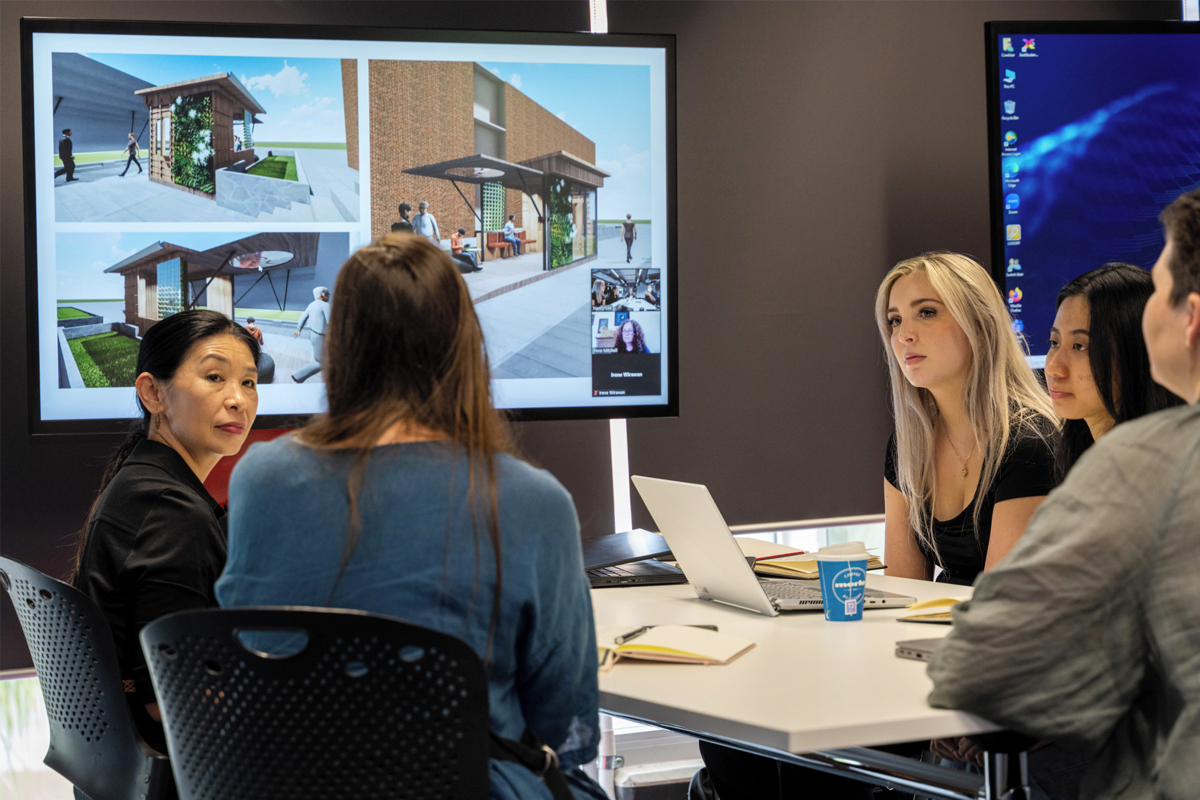
A collaboration between Facilities Management, the Faculty of Engineering and the Faculty of Creative Industries, Education and Social Justice (CIESJ) saw the project embedded into three QUT undergraduate units. In the introductory unit UXB100 Design Thinking for the Built Environment (Faculty of Engineering, School of Architecture and the Built Environment), students were asked to prepare a brief that could actualise the project with a budget of $75,000. This student-led brief was then embedded into two units: DAB101 Architectural Design 1: Explorations (Faculty of Engineering, School of Architecture and the Built Environment) and DYB301 Impact Lab 4: Purpose (Faculty of Creative Industries, Education and Social Justice, School of Design), as a practical, sustainable design project.
Students were required to meet with the client (QUT Sustainability Manager), the Project Manager (QUT Capital Works), Principal Planning and Design Consultant (QUT Estate Planning), QUT’s Elder in Residence and Traditional Owner, and the Deputy Vice-Chancellor (Indigenous Australians) to receive input into brief development and design requirements and guidance on applying QUT’s Campus to Country Positioning Strategy principles. The designs were completed and presented to QUT Facilities Management. Facilities Management went on to select one student design from each unit DAB101 and DYB301 to be developed further and employed two students to work collaboratively with the QUT Sustainability Manager, the QUT capital works team, the architect (Eco Effective Solutions) and the builder (PODcon) to bring their design ideas together and create the final design for the Facilities Management team. The Facilities Management team engaged PODcon to build the design, which was delivered to the Gardens Point campus in early August 2023.
Environmental and social benefits
Environmental Benefits
- The project designs showcase sustainable design methodologies, including a circular economy approach through the use of reused and recycled materials, design for zero waste, and deconstruction at the end of life.
- Educating students on the benefits of incorporating green walls and landscaping into their designs, including for passive cooling, creating edible gardens in urban environments, and increasing biodiversity will have long-lasting environmental benefits.
- This project helped students to consider the urgent need to revisit design’s role in fuelling unsustainable lifestyles and widescale planetary damage, and to bring greater criticality to how designers approach their work and consider more deeply the impacts of their design.
Social Benefits
- The SHED is a space designed by students that will also host activities that support and encourage students to pursue knowledge and discovery outside the classroom. For example, students can get involved in growing and harvesting edible plants within the space, which can then be provided to the students or to the Student Guild for their foodbank.
- Developing a deeper understanding and recognition of Indigenous Australians’ connection to Country and knowledge of sustainability will help students apply their knowledge more broadly across the projects that they will be working on as they enter their chosen careers, benefiting wider society.
- QUT’s Deputy Vice-Chancellor (Indigenous Australians) commented through the engagement process that “It’s about the people in the space, the building is the easy part” and so the SHED has been designed to be a space where we can create deeper connections, share knowledge, and develop a deeper understanding and respect for each other and the environment.
Operational Benefits
- Engagement with QUT’s Elder in Residence and Traditional Owner provided Facilities Management with a deeper understanding and recognition of Indigenous Australians’ connection to Country and has strengthened knowledge of the Campus to Country Positioning Strategy that the team can transfer to other QUT projects.
- The SHED project helped to raise the profile of sustainability on campus and raised awareness of QUT’s commitment to sustainability and the environment amongst the students undertaking the project.
- The SHED is designed to be a sustainability engagement space on campus, helping to raise awareness of QUT’s commitment to sustainability and environment, the Sustainability Action Plan and the progress toward our goals.
- The SHED is designed to be a space where education and information can be shared about QUT’s sustainable campus initiatives including, but not limited to, the installation of solar, recycling and reuse programs, sustainable transport options, procurement activities, the Green Impact Program and biodiversity programs on campus.
- The SHED will be a space where staff and students can provide feedback about sustainability on campus.
- The SHED was designed to be an active or a passive space. When the SHED space is not activated, it will provide a sheltered space on campus, connected to the adjoining garden for staff and students to sit, study, engage, or reflect.
Sector Benefits
- During the project, we have developed videos and a case study outlining the process and the benefits of the project, across education and operations, providing resources that other universities can use when creating projects for students on campus. For more information refer to– Sustainability in Higher Education (the SHED) Project.
- The project contributed key evidence towards the Impact Labs, a set of four units, being awarded a national Australian University Teaching Award for ‘Programs that Enhance Learning’ in 2022. It provides a living example on campus of the outcome of teaching excellence.
Leadership and engagement
- The SHED project was supported by senior QUT staff including the Pro Vice-Chancellor (Sustainability Strategy), the Deputy Vice-Chancellor (Indigenous Australians), QUT’s Elder in Residence and Traditional Owner, the Director, Facilities Management, faculty deans and heads of schools, faculty and school administrators and Facilities Management staff. It took a collaborative and inclusive approach to embedding sustainability and culturally sensitive design into education whilst also providing positive operational outcomes on campus.
- The project provided students with the opportunity to engage with QUT’s Elder in Residence and Traditional Owner and QUT’s Deputy Vice-Chancellor (Indigenous Australians), who were able to guide the students on the Campus to Country Positioning Strategy and what sustainability means for Aboriginal and Torres Strait Islander people, providing a deeper understanding of and respect for First Nations people, their knowledge of sustainability and connection to Country, as well as the history of the land where QUT now stands.
- Several resources have been developed by the Sustainability Manager in collaboration with Marketing and Communications and the faculties and students to assist with communicating the project and its purpose, including the SHED video, the SHED Case Study and a time-lapse video showing the SHED building process (in progress).
- The SHED will be officially opened during QUT Sustainability Week on 21 August 2023. The student designers will be speaking at the event.
Significance to the sector
The SHED project provides an example to the sector of how course work can be translated into real world learning opportunities, through on campus projects that embody sustainability and Campus to Country principles, inspiring students, and potential students to engage in these opportunities now and into the future. The physical structure will provide an enduring example of what is possible when aspiration is connected to opportunity at QUT.
Wider societal impact
- This project provided students with the opportunity to develop theoretical knowledge of societal and global issues, and the capabilities to address these through their design, giving them the confidence to take this knowledge into the real world to benefit current and future generations.
- The SHED isa community space that is not limited to staff and student use. It will encourage the broader community to engage with the campus, our sustainability goals and the United Nations Sustainable Development Goals.
Learner/Graduate employer impact
- The project helped students to develop collaboration and engagement skills across disciplines, providing them with enhanced communication skills ready for real worldpractice.
- Understanding the realities and limitations of projects that are designed to be built, rather than simply conceptualised, and overcoming challenges that are often not experienced until a graduate has worked in the field provided real world learning and skills development.
- Real world projects have benefits to students at various stages of their degree as per the following quotes from first and third year lecturer’s Melanie Finger and Dr Anna Tweeddale. “Projects such as the SHED are imperative for our students as they come near the completion of their design degree. Having a project with a budget and a timeline for actually being built gives our students the real-world experience that they need to go confidently into the workforce.” (Quote from Melanie Finger, Unit Coordinator, Impact Lab 4 – Purpose) and “Encountering a real-world project early in a course enhances student learning by raising awareness of the range of knowledge and skills they will need to master over the course of their degree and gives them insight into why and how those various aspects will be applied in practice.” (Quote from Dr Anna Tweeddale, Unit Coordinator, DAB 101, Architectural Design 1: Explorations)
- The SHED was included in Impact Lab 4 – Purpose. The Impact Labs model of working has been endorsed by the Impact Labs being awarded institutional, national, and global awards for enhancing students’ learning and employability through collaborative and experiential design projects. One recent recognition was through the Australian Awards for University Teaching Award for ‘Programs that Enhance Learning’ in 2022 (p.29). An excerpt from the award booklet states that “Students value the contribution of the labs to their development as ethical designers with enhanced employability.”
- The project allowed all students to transition their ideas from classwork to a real-world scenario and gave the final two students the opportunity to translate what they learned and experienced in the classroom into creating a final design in a series of professional workshops where they were paid to collaborate with each other and to work with the client, the architect and the builder.
- The project contributed to the development of students’ transdisciplinary skills and expanded their outlook, whilst demonstrating each student’s potential to make a positive contribution to sustainability and develop their knowledge of and respect for Indigenous Australians’ connection to Country. Refer to the SHED Video highlighting the sentiments of Impact Lab 4 students and their lecturers.


Top 3 learnings
Supported by
Category finalists
Next Generation Learning & Skills/Winners
Next Generation Learning & Skills/Winners
Next Generation Learning & Skills
Next Generation Learning & Skills
Next Generation Learning & Skills/Winners
Next Generation Learning & Skills/Winners
Next Generation Learning & Skills/Winners
Next Generation Learning & Skills/Winners
Next Generation Learning & Skills category
The SHED is a dedicated space to connect with the community and promote and practice sustainability at QUT and beyond. For practicality, the SHED needed to be able to function as both an active and a passive space, be transportable and be designed for deconstruction. We wanted the SHED to be more than just a space for sustainability; we wanted the project to foster collaboration across university organisational areas and provide students with real world opportunities to engage with Indigenous Australians, clients, the architect, and the builder to create a living design that could be showcased on campus, whilst also providing students with real world professional work experience. We wanted the project to embody the goals of QUT’s Education for Sustainability project (to embed sustainability into all undergraduate courses by 2026), and goals across numerous themes in the Sustainability Action Plan, whilst also considering the principles of QUT’s Campus to Country Positioning Strategy, which outlines the importance of connecting to Country and overlays the Estate Master Plan and the priorities of QUT’s Connections Strategy (2023-2027). The SHED is a small but mighty project embodying QUT values, priorities, and goals whilst also connecting student aspirations to real world opportunities.
A collaboration between Facilities Management, the Faculty of Engineering and the Faculty of Creative Industries, Education and Social Justice (CIESJ) saw the project embedded into three QUT undergraduate units. In the introductory unit UXB100 Design Thinking for the Built Environment (Faculty of Engineering, School of Architecture and the Built Environment), students were asked to prepare a brief that could actualise the project with a budget of $75,000. This student-led brief was then embedded into two units: DAB101 Architectural Design 1: Explorations (Faculty of Engineering, School of Architecture and the Built Environment) and DYB301 Impact Lab 4: Purpose (Faculty of Creative Industries, Education and Social Justice, School of Design), as a practical, sustainable design project.
Students were required to meet with the client (QUT Sustainability Manager), the Project Manager (QUT Capital Works), Principal Planning and Design Consultant (QUT Estate Planning), QUT’s Elder in Residence and Traditional Owner, and the Deputy Vice-Chancellor (Indigenous Australians) to receive input into brief development and design requirements and guidance on applying QUT’s Campus to Country Positioning Strategy principles. The designs were completed and presented to QUT Facilities Management. Facilities Management went on to select one student design from each unit DAB101 and DYB301 to be developed further and employed two students to work collaboratively with the QUT Sustainability Manager, the QUT capital works team, the architect (Eco Effective Solutions) and the builder (PODcon) to bring their design ideas together and create the final design for the Facilities Management team. The Facilities Management team engaged PODcon to build the design, which was delivered to the Gardens Point campus in early August 2023.
Top 3 learnings
Environmental and social benefits
Environmental Benefits
- The project designs showcase sustainable design methodologies, including a circular economy approach through the use of reused and recycled materials, design for zero waste, and deconstruction at the end of life.
- Educating students on the benefits of incorporating green walls and landscaping into their designs, including for passive cooling, creating edible gardens in urban environments, and increasing biodiversity will have long-lasting environmental benefits.
- This project helped students to consider the urgent need to revisit design’s role in fuelling unsustainable lifestyles and widescale planetary damage, and to bring greater criticality to how designers approach their work and consider more deeply the impacts of their design.
Social Benefits
- The SHED is a space designed by students that will also host activities that support and encourage students to pursue knowledge and discovery outside the classroom. For example, students can get involved in growing and harvesting edible plants within the space, which can then be provided to the students or to the Student Guild for their foodbank.
- Developing a deeper understanding and recognition of Indigenous Australians’ connection to Country and knowledge of sustainability will help students apply their knowledge more broadly across the projects that they will be working on as they enter their chosen careers, benefiting wider society.
- QUT’s Deputy Vice-Chancellor (Indigenous Australians) commented through the engagement process that “It’s about the people in the space, the building is the easy part” and so the SHED has been designed to be a space where we can create deeper connections, share knowledge, and develop a deeper understanding and respect for each other and the environment.
Operational Benefits
- Engagement with QUT’s Elder in Residence and Traditional Owner provided Facilities Management with a deeper understanding and recognition of Indigenous Australians’ connection to Country and has strengthened knowledge of the Campus to Country Positioning Strategy that the team can transfer to other QUT projects.
- The SHED project helped to raise the profile of sustainability on campus and raised awareness of QUT’s commitment to sustainability and the environment amongst the students undertaking the project.
- The SHED is designed to be a sustainability engagement space on campus, helping to raise awareness of QUT’s commitment to sustainability and environment, the Sustainability Action Plan and the progress toward our goals.
- The SHED is designed to be a space where education and information can be shared about QUT’s sustainable campus initiatives including, but not limited to, the installation of solar, recycling and reuse programs, sustainable transport options, procurement activities, the Green Impact Program and biodiversity programs on campus.
- The SHED will be a space where staff and students can provide feedback about sustainability on campus.
- The SHED was designed to be an active or a passive space. When the SHED space is not activated, it will provide a sheltered space on campus, connected to the adjoining garden for staff and students to sit, study, engage, or reflect.
Sector Benefits
- During the project, we have developed videos and a case study outlining the process and the benefits of the project, across education and operations, providing resources that other universities can use when creating projects for students on campus. For more information refer to– Sustainability in Higher Education (the SHED) Project.
- The project contributed key evidence towards the Impact Labs, a set of four units, being awarded a national Australian University Teaching Award for ‘Programs that Enhance Learning’ in 2022. It provides a living example on campus of the outcome of teaching excellence.
Leadership and engagement
- The SHED project was supported by senior QUT staff including the Pro Vice-Chancellor (Sustainability Strategy), the Deputy Vice-Chancellor (Indigenous Australians), QUT’s Elder in Residence and Traditional Owner, the Director, Facilities Management, faculty deans and heads of schools, faculty and school administrators and Facilities Management staff. It took a collaborative and inclusive approach to embedding sustainability and culturally sensitive design into education whilst also providing positive operational outcomes on campus.
- The project provided students with the opportunity to engage with QUT’s Elder in Residence and Traditional Owner and QUT’s Deputy Vice-Chancellor (Indigenous Australians), who were able to guide the students on the Campus to Country Positioning Strategy and what sustainability means for Aboriginal and Torres Strait Islander people, providing a deeper understanding of and respect for First Nations people, their knowledge of sustainability and connection to Country, as well as the history of the land where QUT now stands.
- Several resources have been developed by the Sustainability Manager in collaboration with Marketing and Communications and the faculties and students to assist with communicating the project and its purpose, including the SHED video, the SHED Case Study and a time-lapse video showing the SHED building process (in progress).
- The SHED will be officially opened during QUT Sustainability Week on 21 August 2023. The student designers will be speaking at the event.
Significance to the sector
The SHED project provides an example to the sector of how course work can be translated into real world learning opportunities, through on campus projects that embody sustainability and Campus to Country principles, inspiring students, and potential students to engage in these opportunities now and into the future. The physical structure will provide an enduring example of what is possible when aspiration is connected to opportunity at QUT.
Wider societal impact
- This project provided students with the opportunity to develop theoretical knowledge of societal and global issues, and the capabilities to address these through their design, giving them the confidence to take this knowledge into the real world to benefit current and future generations.
- The SHED isa community space that is not limited to staff and student use. It will encourage the broader community to engage with the campus, our sustainability goals and the United Nations Sustainable Development Goals.
Learner/Graduate employer impact
- The project helped students to develop collaboration and engagement skills across disciplines, providing them with enhanced communication skills ready for real worldpractice.
- Understanding the realities and limitations of projects that are designed to be built, rather than simply conceptualised, and overcoming challenges that are often not experienced until a graduate has worked in the field provided real world learning and skills development.
- Real world projects have benefits to students at various stages of their degree as per the following quotes from first and third year lecturer’s Melanie Finger and Dr Anna Tweeddale. “Projects such as the SHED are imperative for our students as they come near the completion of their design degree. Having a project with a budget and a timeline for actually being built gives our students the real-world experience that they need to go confidently into the workforce.” (Quote from Melanie Finger, Unit Coordinator, Impact Lab 4 – Purpose) and “Encountering a real-world project early in a course enhances student learning by raising awareness of the range of knowledge and skills they will need to master over the course of their degree and gives them insight into why and how those various aspects will be applied in practice.” (Quote from Dr Anna Tweeddale, Unit Coordinator, DAB 101, Architectural Design 1: Explorations)
- The SHED was included in Impact Lab 4 – Purpose. The Impact Labs model of working has been endorsed by the Impact Labs being awarded institutional, national, and global awards for enhancing students’ learning and employability through collaborative and experiential design projects. One recent recognition was through the Australian Awards for University Teaching Award for ‘Programs that Enhance Learning’ in 2022 (p.29). An excerpt from the award booklet states that “Students value the contribution of the labs to their development as ethical designers with enhanced employability.”
- The project allowed all students to transition their ideas from classwork to a real-world scenario and gave the final two students the opportunity to translate what they learned and experienced in the classroom into creating a final design in a series of professional workshops where they were paid to collaborate with each other and to work with the client, the architect and the builder.
- The project contributed to the development of students’ transdisciplinary skills and expanded their outlook, whilst demonstrating each student’s potential to make a positive contribution to sustainability and develop their knowledge of and respect for Indigenous Australians’ connection to Country. Refer to the SHED Video highlighting the sentiments of Impact Lab 4 students and their lecturers.
Supported by
Category finalists
Next Generation Learning & Skills/Winners
Next Generation Learning & Skills/Winners
Next Generation Learning & Skills
Next Generation Learning & Skills
Next Generation Learning & Skills/Winners
Next Generation Learning & Skills/Winners
Next Generation Learning & Skills/Winners
Next Generation Learning & Skills/Winners