Creating Impact category
In 2022, The University of Queensland (UQ) Art Museum achieved carbon neutral certification for its five-month Oceanic Thinking event. The museum partnered with the UQ Sustainability office, working together closely before, during and after the event to complete the certification process. The sustainability office provided carbon accounting technical expertise and general sustainability advice, while UQ Art Museum executed on emissions-reduction activities and event production.
Running from February to June, the Oceanic Thinking exhibition presented new ways of understanding the ocean and our planet. Australian indigenous and other local works sat alongside pieces from Los Angeles, Copenhagen, Cape Town and beyond, providing rich international perspectives on humanity’s relationship with one of our most valuable resources. Thousands of students, staff members and external visitors engaged with the five-month long event.
The exhibition also provided the opportunity to explore a number of sustainability topics relevant across the tertiary education sector. Namely, how can institutions deliver the benefits of large-scale, ideas-focused, change-making events, while also managing environmental impact? And how can they go about measuring – and reducing – such factors in a way that is transparent and replicable?
Many universities strive to be sustainability leaders, yet we are also leaders in creativity and information sharing. The pandemic provided the sector with the impetus to design a successful digital model for collaboration – and we now need to ensure we have ways to combine that with sustainable in-person participation over the long term.
The carbon neutral certification of the UQ Art Museum Oceanic Thinking exhibition demonstrates a successful approach. Our methodology, which is publicly available via UQ’s Public Disclosure Statement on the website of certifying body Climate Active, may be useful to a wide range of educational institutions, galleries or event organisers.
And while formal certification is a rigorous, technical and time-consuming process, developing the capability of carbon neutral accounting – and, more fundamentally, carbon emissions-reduction activities – will be essential to all organisations as the world’s focus narrows in on sustainability commitments.
By achieving carbon neutral certification for the Oceanic Thinking exhibition at UQ Art Museum, we learned that it is only by undertaking the complete process that an organisation is likely to truly understand its carbon position. Identifying emission sources, collecting data, conducting inventories, testing assumptions and designing reduction strategies – none of these things are easy to do. UQ can now take all these learnings to continue building future capability and efficiencies in this space.
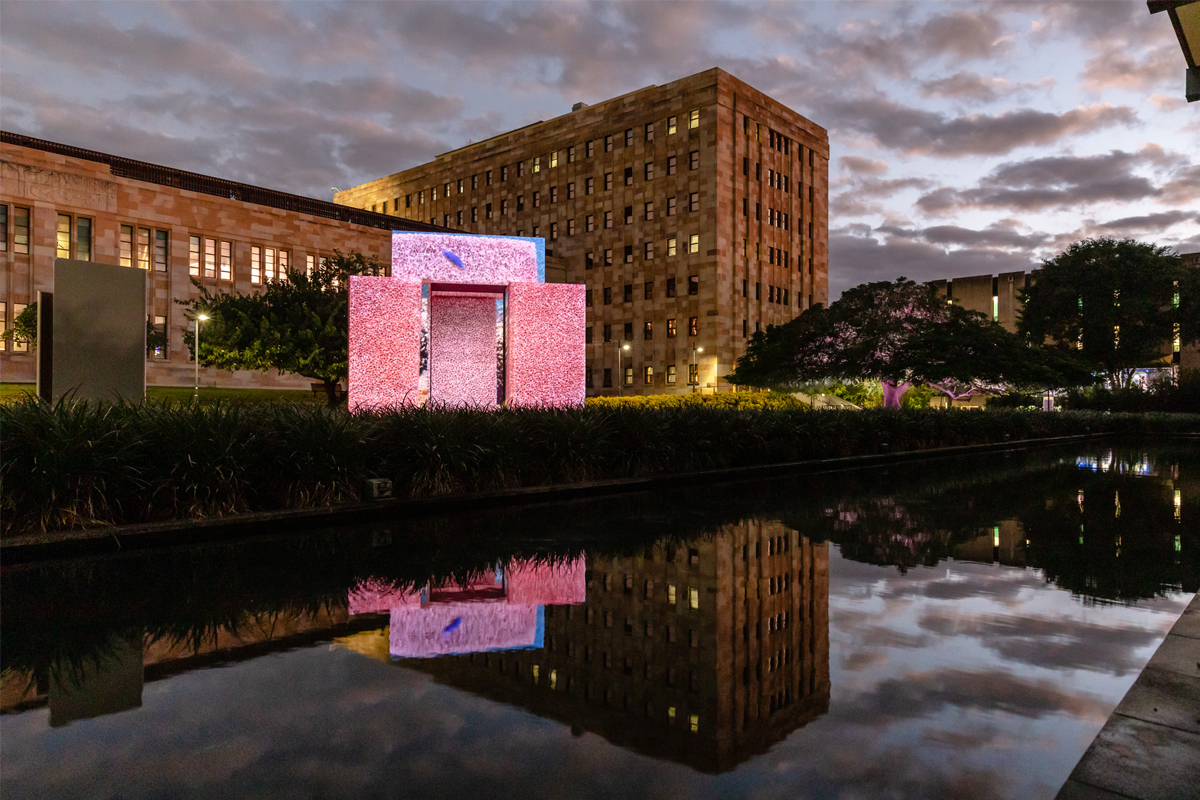
Environmental and social benefits
UQ has acquired an invaluable body of corporate knowledge around carbon neutral certification. Understanding the Climate Active Carbon Neutral Standard involves a significant time investment. This project was a pilot; however, the methodology, materiality assessments, calculators and assurance required are common whether certifying an institution, internal division, precinct, campus or event. This operational outcome may translate into direct environmental benefits in the future, as we now have insights into how to develop a carbon neutral certification.
However, creating a carbon neutral event was also immensely valuable as a standalone exercise. This project pioneered a carbon neutral physical event approach for the tertiary education sector. At the time of submission, only five other universities appear to have certifications on the Climate Active database, and none of these are for a large-scale event over an extended time period. As per the database, UQ Art Museum is also the first university art museum to achieve any carbon neutral certification, the first gallery or museum in Queensland and only the fourth nationally.
Hosting a carbon neutral event also enabled UQ Art Museum to gain a detailed understanding of its carbon footprint and biggest emissions sources. It is now able to apply this knowledge to all of its exhibitions and operations. In terms of improved environmental outcomes at Oceanic Thinking, museum curators made conscious choices to reduce the waste profile, introducing elements such as temporary art display walls made from reusable and recyclable cardboard. Catering was another key area, with plant-based food and compostable serving ware provided at events.
Leadership and engagement
We know there are a small number of other Australian universities that have also completed a carbon neutral certification process, but with different areas of focus (for e.g. business operations or specific campuses). We set out to prove a replicable approach for hosting sustainable events, which would be relevant across the tertiary education sector.
UQ is also the largest university (by number of students) to undertake a carbon certification process, according to our research. We mention this as relevant because certification is one initiative where we believe size does affect the complexity of the task. Our own conversations with other large institutions suggest that this complexity is an off-putting factor for many, and so we initiated a pilot in order to collect and share learnings and be able to confidently lead in this space.
Significance to the sector
As we have spoken about in the previous Leadership section, we believe that successfully delivering a carbon neutral event has immense value for the sector. While we have learned that certification is a highly technical, rigorous and time-consuming process, we can also see a pathway for universities that may not be resourced to take on the formal process nonetheless achieving more sustainable events by following many aspects of the methodology.
Moreover, we believe that the value for universities in developing capabilities in carbon emissions reduction and carbon accounting is high. Public carbon emission reporting isn’t mandatory yet, but it may well be in the future. Having gone through the process, we now understand just how challenging it can be to build these skills and systems. We are making a number of changes to our data collection and reporting framework as a result of this pilot. So, for any institutions wanting to trial a carbon neutral approach, we would say: the small pilot approach worked well for us. Selecting a physical space that was self-contained meant we had neat concise boundaries from which to extract water use, energy consumption and so on. We were able to collect detailed learnings from which we could build a broader business case.
Wider societal impact
UQ Art Museum provides free access to the public for the majority of its exhibitions, including Oceanic Thinking. By linking a technical carbon accounting focus to an arts program, we created new opportunities to talk about the practical realities of achieving carbon neutral status. More specifically, we expanded the audience that might usually discuss those messages from a scientific or operationally-focused core group to a multidisciplinary and diversely-thinking assembly. Conversely, scientists and other professionals involved were also prompted to consider new ways of communicating about climate and climate change, highlighting the importance of going beyond facts and figures to create impact.
The multiplier effect of thousands of people attending an exhibition has significant potential to inspire action. Art by its very nature assists in amplifying ideas, as gallery works are selected to prompt conversation and reflection. If each attendee talks about the event or art with even one other person, the potential sphere of impact has already doubled.
In addition to featuring in the internal UQ News, our carbon neutral certification also received arts industry coverage when the UQ Art Museum won the Sustainability category in the 2022 Gallery and Museum Achievement Awards, awarded by the state’s peak body Museums and Galleries Queensland. This further increased our audience exposure, and where raising awareness plays a big role in driving behavioural change, the more people talking about our certification, the better.
Learner/Graduate employer impact
Although perhaps varying in terms of definition, ‘sustainability skills’ and certainly ‘sustainability awareness’ are cited by many potential future employers as valued capabilities among graduate students. This holds true regardless of industry, with professions from engineering to data science, communication to human resources and almost anything else in between incorporating sustainability into many job descriptions.
Several courses interacted with the Oceanic Thinking exhibition, including Architecture, Environmental Science and Art History. This engagement was done in various ways from class visits and tours to assessment projects that drew on themes and artworks in the exhibition. For example, architecture students were inspired by an installation by Danish artist collective Superflex, whose work directly addresses a future impacted by climate change, imagining a world where sea levels have risen. Students were asked to design their own floating structures. Each group – and individual – that was involved with the exhibition had the opportunity to appreciate how climate change isn’t just about data and research. It needs the skills of creativity and art too. And where sustainability, carbon emissions and climate action thinking have been embedded into education, students take all that knowledge and altered outlook with them to their future employers.
Outside of pedagogy, many of the public program experiences also functioned as touch points and prompts for students to engage with sustainability thinking and carbon emissions reduction. A Marine Social Sciences symposium drew students from a range of disciplines, as did a talk from Professor Catherine Lovelock, who discussed her blue carbon research. One Environmental Science student was overheard to say it was the first time so far in their degree they had felt hopeful that solutions to climate change could still be found. In other words, taking the content and applying it in a new context had opened up new ideas and possibilities for them.



Top 3 learnings
Supported by

Category finalists
Creating Impact/Winners
Creating Impact/Winners
Creating Impact/Winners
Creating Impact/Winners
Creating Impact/Winners
Creating Impact/Winners
Creating Impact
Creating Impact
Creating Impact category
In 2022, The University of Queensland (UQ) Art Museum achieved carbon neutral certification for its five-month Oceanic Thinking event. The museum partnered with the UQ Sustainability office, working together closely before, during and after the event to complete the certification process. The sustainability office provided carbon accounting technical expertise and general sustainability advice, while UQ Art Museum executed on emissions-reduction activities and event production.
Running from February to June, the Oceanic Thinking exhibition presented new ways of understanding the ocean and our planet. Australian indigenous and other local works sat alongside pieces from Los Angeles, Copenhagen, Cape Town and beyond, providing rich international perspectives on humanity’s relationship with one of our most valuable resources. Thousands of students, staff members and external visitors engaged with the five-month long event.
The exhibition also provided the opportunity to explore a number of sustainability topics relevant across the tertiary education sector. Namely, how can institutions deliver the benefits of large-scale, ideas-focused, change-making events, while also managing environmental impact? And how can they go about measuring – and reducing – such factors in a way that is transparent and replicable?
Many universities strive to be sustainability leaders, yet we are also leaders in creativity and information sharing. The pandemic provided the sector with the impetus to design a successful digital model for collaboration – and we now need to ensure we have ways to combine that with sustainable in-person participation over the long term.
The carbon neutral certification of the UQ Art Museum Oceanic Thinking exhibition demonstrates a successful approach. Our methodology, which is publicly available via UQ’s Public Disclosure Statement on the website of certifying body Climate Active, may be useful to a wide range of educational institutions, galleries or event organisers.
And while formal certification is a rigorous, technical and time-consuming process, developing the capability of carbon neutral accounting – and, more fundamentally, carbon emissions-reduction activities – will be essential to all organisations as the world’s focus narrows in on sustainability commitments.
By achieving carbon neutral certification for the Oceanic Thinking exhibition at UQ Art Museum, we learned that it is only by undertaking the complete process that an organisation is likely to truly understand its carbon position. Identifying emission sources, collecting data, conducting inventories, testing assumptions and designing reduction strategies – none of these things are easy to do. UQ can now take all these learnings to continue building future capability and efficiencies in this space.
Top 3 learnings
Environmental and social benefits
UQ has acquired an invaluable body of corporate knowledge around carbon neutral certification. Understanding the Climate Active Carbon Neutral Standard involves a significant time investment. This project was a pilot; however, the methodology, materiality assessments, calculators and assurance required are common whether certifying an institution, internal division, precinct, campus or event. This operational outcome may translate into direct environmental benefits in the future, as we now have insights into how to develop a carbon neutral certification.
However, creating a carbon neutral event was also immensely valuable as a standalone exercise. This project pioneered a carbon neutral physical event approach for the tertiary education sector. At the time of submission, only five other universities appear to have certifications on the Climate Active database, and none of these are for a large-scale event over an extended time period. As per the database, UQ Art Museum is also the first university art museum to achieve any carbon neutral certification, the first gallery or museum in Queensland and only the fourth nationally.
Hosting a carbon neutral event also enabled UQ Art Museum to gain a detailed understanding of its carbon footprint and biggest emissions sources. It is now able to apply this knowledge to all of its exhibitions and operations. In terms of improved environmental outcomes at Oceanic Thinking, museum curators made conscious choices to reduce the waste profile, introducing elements such as temporary art display walls made from reusable and recyclable cardboard. Catering was another key area, with plant-based food and compostable serving ware provided at events.
Leadership and engagement
We know there are a small number of other Australian universities that have also completed a carbon neutral certification process, but with different areas of focus (for e.g. business operations or specific campuses). We set out to prove a replicable approach for hosting sustainable events, which would be relevant across the tertiary education sector.
UQ is also the largest university (by number of students) to undertake a carbon certification process, according to our research. We mention this as relevant because certification is one initiative where we believe size does affect the complexity of the task. Our own conversations with other large institutions suggest that this complexity is an off-putting factor for many, and so we initiated a pilot in order to collect and share learnings and be able to confidently lead in this space.
Significance to the sector
As we have spoken about in the previous Leadership section, we believe that successfully delivering a carbon neutral event has immense value for the sector. While we have learned that certification is a highly technical, rigorous and time-consuming process, we can also see a pathway for universities that may not be resourced to take on the formal process nonetheless achieving more sustainable events by following many aspects of the methodology.
Moreover, we believe that the value for universities in developing capabilities in carbon emissions reduction and carbon accounting is high. Public carbon emission reporting isn’t mandatory yet, but it may well be in the future. Having gone through the process, we now understand just how challenging it can be to build these skills and systems. We are making a number of changes to our data collection and reporting framework as a result of this pilot. So, for any institutions wanting to trial a carbon neutral approach, we would say: the small pilot approach worked well for us. Selecting a physical space that was self-contained meant we had neat concise boundaries from which to extract water use, energy consumption and so on. We were able to collect detailed learnings from which we could build a broader business case.
Wider societal impact
UQ Art Museum provides free access to the public for the majority of its exhibitions, including Oceanic Thinking. By linking a technical carbon accounting focus to an arts program, we created new opportunities to talk about the practical realities of achieving carbon neutral status. More specifically, we expanded the audience that might usually discuss those messages from a scientific or operationally-focused core group to a multidisciplinary and diversely-thinking assembly. Conversely, scientists and other professionals involved were also prompted to consider new ways of communicating about climate and climate change, highlighting the importance of going beyond facts and figures to create impact.
The multiplier effect of thousands of people attending an exhibition has significant potential to inspire action. Art by its very nature assists in amplifying ideas, as gallery works are selected to prompt conversation and reflection. If each attendee talks about the event or art with even one other person, the potential sphere of impact has already doubled.
In addition to featuring in the internal UQ News, our carbon neutral certification also received arts industry coverage when the UQ Art Museum won the Sustainability category in the 2022 Gallery and Museum Achievement Awards, awarded by the state’s peak body Museums and Galleries Queensland. This further increased our audience exposure, and where raising awareness plays a big role in driving behavioural change, the more people talking about our certification, the better.
Learner/Graduate employer impact
Although perhaps varying in terms of definition, ‘sustainability skills’ and certainly ‘sustainability awareness’ are cited by many potential future employers as valued capabilities among graduate students. This holds true regardless of industry, with professions from engineering to data science, communication to human resources and almost anything else in between incorporating sustainability into many job descriptions.
Several courses interacted with the Oceanic Thinking exhibition, including Architecture, Environmental Science and Art History. This engagement was done in various ways from class visits and tours to assessment projects that drew on themes and artworks in the exhibition. For example, architecture students were inspired by an installation by Danish artist collective Superflex, whose work directly addresses a future impacted by climate change, imagining a world where sea levels have risen. Students were asked to design their own floating structures. Each group – and individual – that was involved with the exhibition had the opportunity to appreciate how climate change isn’t just about data and research. It needs the skills of creativity and art too. And where sustainability, carbon emissions and climate action thinking have been embedded into education, students take all that knowledge and altered outlook with them to their future employers.
Outside of pedagogy, many of the public program experiences also functioned as touch points and prompts for students to engage with sustainability thinking and carbon emissions reduction. A Marine Social Sciences symposium drew students from a range of disciplines, as did a talk from Professor Catherine Lovelock, who discussed her blue carbon research. One Environmental Science student was overheard to say it was the first time so far in their degree they had felt hopeful that solutions to climate change could still be found. In other words, taking the content and applying it in a new context had opened up new ideas and possibilities for them.
Supported by
Category finalists
Creating Impact/Winners
Creating Impact/Winners
Creating Impact/Winners
Creating Impact/Winners
Creating Impact/Winners
Creating Impact/Winners
Creating Impact
Creating Impact