Creating Impact category
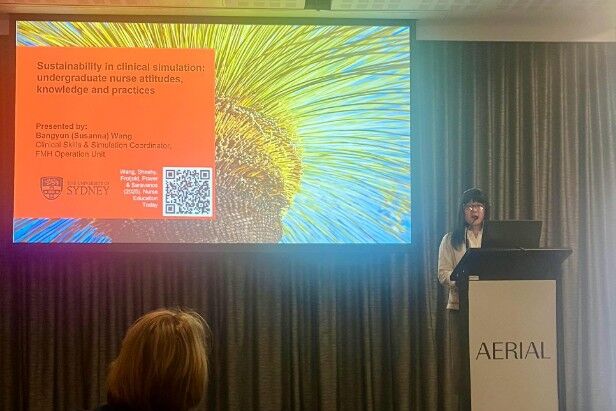
The University of Sydney’s Beyond the Cohort: Building Sustainable Systems in Healthcare Education addresses the environmental impact of clinical simulation, one of the most consumable-intensive teaching environments in health education. The project responds to a sector gap by creating sustainability guidelines, waste diversion pathways and reuse protocols for simulation settings without compromising educational quality or clinical fidelity.
Led by a small Faculty of Medicine and Health team using faculty operational funding, the project established a structured waste diversion workflow through Medcycle, embedded a sustainability learning module into simulation teaching, and developed co-designed guidelines now adopted across multiple sites. The project has also produced a peer-reviewed publication, practical guidelines for sector-wide adoption, and an invitation to present at Laerdal Medical’s SUN Conference 2026, demonstrating its value as a scalable model for embedding sustainability into healthcare education.
Impacts & Benefits
- Diverted 1,589.3 kg of clinical simulation consumables from waste streams across 172 collections in the 12 months to May 2026.
- Achieved a very low contamination rate, with only 1.1% of collected material unable to be recycled and 98.9% entering circular pathways.
- Reduced sharps waste by 22%, based on waste audits following the simulation sustainability intervention.
- Improved student sustainability practice, with a published study showing significant increases in students’ perceived application of sustainability during simulation.
- Created financial and operational benefits, reducing reliance on costly clinical waste disposal and lowering consumable use through standardised simulation kits.
Leadership & Engagement
- Created new sustainability practice in clinical simulation, establishing guidelines where no Australian university model was previously known to exist.
- Used co-design to drive adoption, engaging approximately 40–45 academic, clinical, professional and operational staff across five sites.
- Embedded sustainability into curriculum and operations, combining a learning module, Medcycle workflow and site-specific procedures.
- Scaled from one pilot site to three locations, including Concord Clinical School, Susan Wakil Health Building, Westmead Innovation centre. And planning to roll out to Northern clinical school and Nepean clinical school during the second half of 2026.
- Built an evidence-based model for the sector, supported by peer-reviewed research, waste audits, operational data and conference dissemination.
Wider Societal Impact
- Addressed healthcare’s material footprint, creating a pathway from sustainable simulation training to lower-impact clinical practice.
- Prepared future health professionals for responsible resource use, embedding reduce, reuse and recycle habits into realistic clinical learning.
- Created a model relevant beyond universities, with potential application in hospitals, vocational training, emergency services, laboratories and other simulation-based settings.
- Influenced the wider simulation sector, including through an invitation to present to an international audience hosted by Laerdal Medical.
- Opened pathways for health system adoption, with the model offering potential for NSW Health and other healthcare providers where consumable volumes are significantly larger.

Top 3 learnings
Supported by

Category finalists
Creating Impact
Creating Impact
Creating Impact
Creating Impact

Creating Impact
Creating Impact
Creating Impact category
The University of Sydney’s Beyond the Cohort: Building Sustainable Systems in Healthcare Education addresses the environmental impact of clinical simulation, one of the most consumable-intensive teaching environments in health education. The project responds to a sector gap by creating sustainability guidelines, waste diversion pathways and reuse protocols for simulation settings without compromising educational quality or clinical fidelity.
Led by a small Faculty of Medicine and Health team using faculty operational funding, the project established a structured waste diversion workflow through Medcycle, embedded a sustainability learning module into simulation teaching, and developed co-designed guidelines now adopted across multiple sites. The project has also produced a peer-reviewed publication, practical guidelines for sector-wide adoption, and an invitation to present at Laerdal Medical’s SUN Conference 2026, demonstrating its value as a scalable model for embedding sustainability into healthcare education.
Top 3 learnings
Impacts & Benefits
- Diverted 1,589.3 kg of clinical simulation consumables from waste streams across 172 collections in the 12 months to May 2026.
- Achieved a very low contamination rate, with only 1.1% of collected material unable to be recycled and 98.9% entering circular pathways.
- Reduced sharps waste by 22%, based on waste audits following the simulation sustainability intervention.
- Improved student sustainability practice, with a published study showing significant increases in students’ perceived application of sustainability during simulation.
- Created financial and operational benefits, reducing reliance on costly clinical waste disposal and lowering consumable use through standardised simulation kits.
Leadership & Engagement
- Created new sustainability practice in clinical simulation, establishing guidelines where no Australian university model was previously known to exist.
- Used co-design to drive adoption, engaging approximately 40–45 academic, clinical, professional and operational staff across five sites.
- Embedded sustainability into curriculum and operations, combining a learning module, Medcycle workflow and site-specific procedures.
- Scaled from one pilot site to three locations, including Concord Clinical School, Susan Wakil Health Building, Westmead Innovation centre. And planning to roll out to Northern clinical school and Nepean clinical school during the second half of 2026.
- Built an evidence-based model for the sector, supported by peer-reviewed research, waste audits, operational data and conference dissemination.
Wider Societal Impact
- Addressed healthcare’s material footprint, creating a pathway from sustainable simulation training to lower-impact clinical practice.
- Prepared future health professionals for responsible resource use, embedding reduce, reuse and recycle habits into realistic clinical learning.
- Created a model relevant beyond universities, with potential application in hospitals, vocational training, emergency services, laboratories and other simulation-based settings.
- Influenced the wider simulation sector, including through an invitation to present to an international audience hosted by Laerdal Medical.
- Opened pathways for health system adoption, with the model offering potential for NSW Health and other healthcare providers where consumable volumes are significantly larger.
Supported by
Category finalists
Creating Impact
Creating Impact
Creating Impact
Creating Impact
Creating Impact
Creating Impact