Student Engagement category
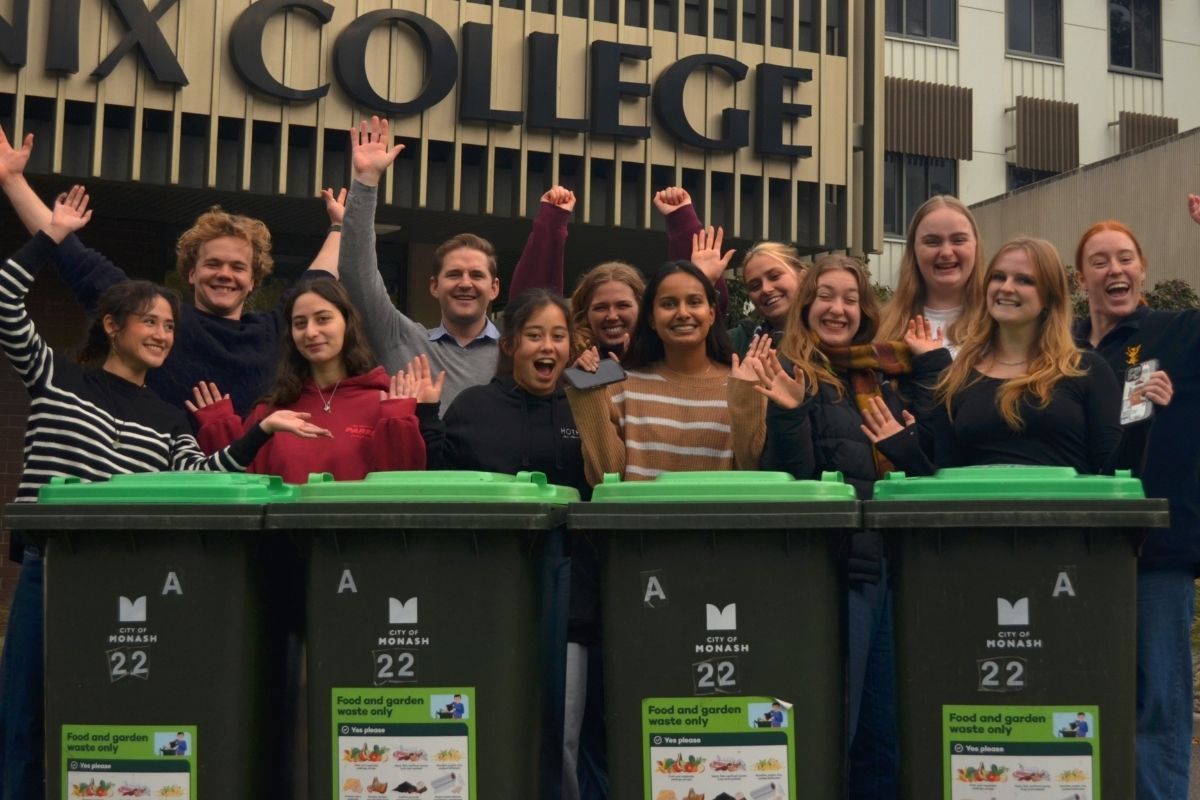
Mannix College, affiliated with Monash University has launched the “Green Cuisine: Waste Not Want Not” initiative, a student-driven project aimed at revolutionising food and organic waste management within the college. Spearheaded by the Environment & Sustainability Advisory Committee and supported by Monash City Council, the initiative focuses on reducing food waste in the college’s dining hall. The project introduced organic waste bins, resulting in a 60% reduction in food waste and diverting 9,600 kg of organic waste from landfills in six months. This initiative significantly reduces the college’s environmental footprint and promotes sustainability within the campus community.
Environmental and Social Benefits
- CO2 Emissions Reduction: By diverting 9,600 kg of organic waste from landfills, the initiative has prevented 15.84 tonnes of CO2 equivalent emissions in just six months. The project is projected to prevent 31.68 tonnes of CO2e annually.
- Circular Economy Promotion: The initiative contributes to the circular economy by transforming food waste into 3,840 kg of nutrient-rich compost, which supports local agriculture and reduces the need for chemical fertilisers.
- Community Engagement: The project has fostered a strong sense of community among students and staff, raising awareness and encouraging eco-conscious behaviours within the college.
Leadership and Engagement
- Student-Driven Initiative: The project is distinctive for its student-led approach, with the Environment & Sustainability Advisory Committee playing a central role in planning, executing, and monitoring the initiative. Students led educational campaigns, workshops, and social media projects to promote awareness and proper waste segregation.
- Collaboration with Local Authorities: The partnership with Monash City Council was crucial in implementing the project, providing organic waste bins and composting services. This collaboration ensured the project’s success and demonstrated the importance of local government partnerships in achieving sustainability goals.
- Active Participation: Over 300 students and 20 staff members participated in the project, with all members of the college community contributing to the initiative’s success. The collective effort highlights the importance of community-wide engagement in sustainability projects.
Significance to the Sector
- Innovative Model: The initiative is the first of its kind in Australia, showcasing a successful partnership between a residential college and a local city council. The project’s comprehensive approach and significant environmental impact make it a model for other institutions to replicate.
- Scalability and Replicability: The project’s success at Mannix College demonstrates its potential for replication across other university campuses and student accommodation providers. With 30,000 university students living in catered accommodation in Australia, the initiative has the potential to make a significant impact on a national scale.
- Contribution to SDGs: The initiative aligns with the UN Sustainable Development Goals (SDGs), particularly Goal 12 (Responsible Consumption and Production) and Goal 13 (Climate Action), by promoting sustainable waste management practices and reducing the carbon footprint.
Wider Societal Impact
- Educational Impact: The initiative has equipped students with valuable skills in project management, leadership, and sustainability, preparing them to be environmentally responsible leaders in their future careers. The program’s success has also inspired similar initiatives within the wider community, promoting sustainable practices beyond the college.
- Long-Term Sustainability: The project has set a precedent for long-term sustainability within the college. Future plans include leveraging data analytics to optimise waste management efficiency, ensuring continuous improvement, and maintaining the initiative’s impact over time.
- Broader Influence: The initiative’s principles and practices are relevant to other sectors, such as hospitality, healthcare, and schools, which face similar waste management challenges. The project’s success at Mannix College provides a replicable model that can be adapted to various contexts, promoting sustainability on a broader scale.
The “Green Cuisine: Waste Not Want Not” initiative at Mannix College, affiliated with Monash University, exemplifies a successful, scalable approach to sustainable waste management in a student accommodation setting. Through student leadership, strategic partnerships, and community engagement, the initiative has significantly reduced the college’s environmental footprint and fostered a culture of sustainability within the campus community. This project serves as a model for other institutions and sectors, demonstrating the powerful impact of collective action in achieving environmental goals.

Top 3 learnings
Supported by

Category finalists

Student Engagement/Winners
Student Engagement/Winners
Student Engagement category
Mannix College, affiliated with Monash University has launched the “Green Cuisine: Waste Not Want Not” initiative, a student-driven project aimed at revolutionising food and organic waste management within the college. Spearheaded by the Environment & Sustainability Advisory Committee and supported by Monash City Council, the initiative focuses on reducing food waste in the college’s dining hall. The project introduced organic waste bins, resulting in a 60% reduction in food waste and diverting 9,600 kg of organic waste from landfills in six months. This initiative significantly reduces the college’s environmental footprint and promotes sustainability within the campus community.
Top 3 learnings
Environmental and Social Benefits
- CO2 Emissions Reduction: By diverting 9,600 kg of organic waste from landfills, the initiative has prevented 15.84 tonnes of CO2 equivalent emissions in just six months. The project is projected to prevent 31.68 tonnes of CO2e annually.
- Circular Economy Promotion: The initiative contributes to the circular economy by transforming food waste into 3,840 kg of nutrient-rich compost, which supports local agriculture and reduces the need for chemical fertilisers.
- Community Engagement: The project has fostered a strong sense of community among students and staff, raising awareness and encouraging eco-conscious behaviours within the college.
Leadership and Engagement
- Student-Driven Initiative: The project is distinctive for its student-led approach, with the Environment & Sustainability Advisory Committee playing a central role in planning, executing, and monitoring the initiative. Students led educational campaigns, workshops, and social media projects to promote awareness and proper waste segregation.
- Collaboration with Local Authorities: The partnership with Monash City Council was crucial in implementing the project, providing organic waste bins and composting services. This collaboration ensured the project’s success and demonstrated the importance of local government partnerships in achieving sustainability goals.
- Active Participation: Over 300 students and 20 staff members participated in the project, with all members of the college community contributing to the initiative’s success. The collective effort highlights the importance of community-wide engagement in sustainability projects.
Significance to the Sector
- Innovative Model: The initiative is the first of its kind in Australia, showcasing a successful partnership between a residential college and a local city council. The project’s comprehensive approach and significant environmental impact make it a model for other institutions to replicate.
- Scalability and Replicability: The project’s success at Mannix College demonstrates its potential for replication across other university campuses and student accommodation providers. With 30,000 university students living in catered accommodation in Australia, the initiative has the potential to make a significant impact on a national scale.
- Contribution to SDGs: The initiative aligns with the UN Sustainable Development Goals (SDGs), particularly Goal 12 (Responsible Consumption and Production) and Goal 13 (Climate Action), by promoting sustainable waste management practices and reducing the carbon footprint.
Wider Societal Impact
- Educational Impact: The initiative has equipped students with valuable skills in project management, leadership, and sustainability, preparing them to be environmentally responsible leaders in their future careers. The program’s success has also inspired similar initiatives within the wider community, promoting sustainable practices beyond the college.
- Long-Term Sustainability: The project has set a precedent for long-term sustainability within the college. Future plans include leveraging data analytics to optimise waste management efficiency, ensuring continuous improvement, and maintaining the initiative’s impact over time.
- Broader Influence: The initiative’s principles and practices are relevant to other sectors, such as hospitality, healthcare, and schools, which face similar waste management challenges. The project’s success at Mannix College provides a replicable model that can be adapted to various contexts, promoting sustainability on a broader scale.
The “Green Cuisine: Waste Not Want Not” initiative at Mannix College, affiliated with Monash University, exemplifies a successful, scalable approach to sustainable waste management in a student accommodation setting. Through student leadership, strategic partnerships, and community engagement, the initiative has significantly reduced the college’s environmental footprint and fostered a culture of sustainability within the campus community. This project serves as a model for other institutions and sectors, demonstrating the powerful impact of collective action in achieving environmental goals.
Supported by
Category finalists
Student Engagement/Winners
Student Engagement/Winners