Creating Impact category
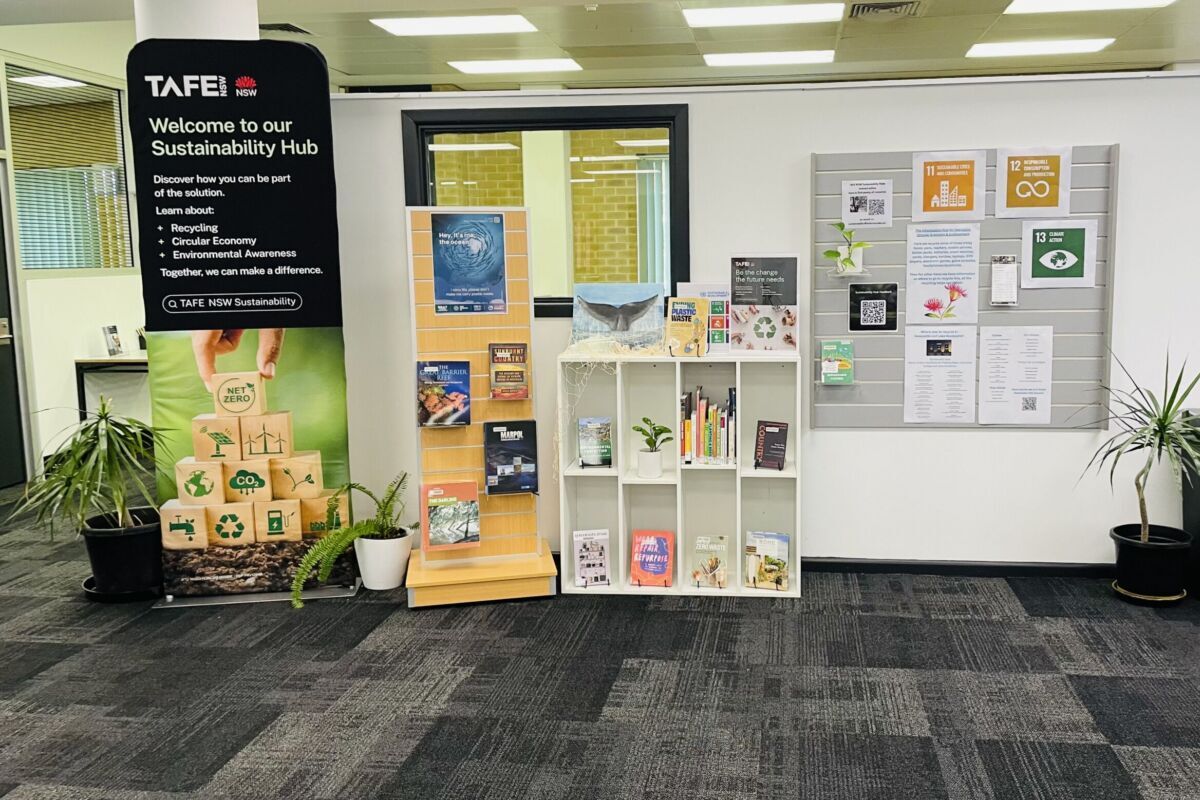
TAFE NSW’s “Sustainability Library Hubs” initiative has transformed library spaces across eight campuses into vibrant, accessible sustainability hubs. These pilot hubs were launched in early 2025 to promote environmental literacy and foster grassroots climate action, supporting the objectives of TAFE NSW’s Sustainability Strategy. Designed and led by staff with minimal funding, the hubs showcase sustainable practices, provide tricky-to-recycle drop-off points, and offer engaging themed displays and literacy sessions. They have become catalysts for change across diverse campuses and communities, creating practical pathways to build awareness and shift behaviours in favour of a more sustainable future.
Environmental and Social Benefits
- Diverted significant waste from landfill through onsite recycling of batteries, blister packs, e-waste, and more, including over 85 blister packs and 4kg of batteries at one site alone.
- Offered a welcoming and inclusive space where students and staff could learn and act on sustainability in practical ways, including sustainability-themed events and resources.
- Created standardised environmental literacy sessions and a central online support guide accessed nearly 400 times in the first three months.
Leadership and Engagement
- Co-designed by staff from Library Services and the Sustainability Team, backed by a strong governance structure and executive support.
- Staff-led with broad participation: 11 Library Sustainability Advocates led activations, with further engagement from students, teachers, and local communities.
- Leadership buy-in and promotion through internal communications and national library networks helped inspire interest across NSW and beyond.
Significance to the Sector
- Demonstrates how low-cost, high-impact sustainability action can be implemented at scale using existing campus infrastructure.
- Model is adaptable for a wide range of institutions, allowing local tailoring and use of community partnerships.
- Online Library Support Guide ensures state-wide access, while data collection and feedback loops support continuous improvement.
Wider Societal Impact
- Builds local partnerships with councils and community groups to extend sustainability messaging beyond campus.
- Empowers disadvantaged students, including Aboriginal and Torres Strait Islander learners, learners from CALD backgrounds, and students with disabilities.
- Encourages values-driven decision-making and behaviour change among students, with effects likely to filter into workplaces and communities.

Top 3 learnings
Supported by
Category finalists

Creating Impact
Creating Impact

Creating Impact
Creating Impact

Creating Impact
Creating Impact
Creating Impact category
TAFE NSW’s “Sustainability Library Hubs” initiative has transformed library spaces across eight campuses into vibrant, accessible sustainability hubs. These pilot hubs were launched in early 2025 to promote environmental literacy and foster grassroots climate action, supporting the objectives of TAFE NSW’s Sustainability Strategy. Designed and led by staff with minimal funding, the hubs showcase sustainable practices, provide tricky-to-recycle drop-off points, and offer engaging themed displays and literacy sessions. They have become catalysts for change across diverse campuses and communities, creating practical pathways to build awareness and shift behaviours in favour of a more sustainable future.
Top 3 learnings
Environmental and Social Benefits
- Diverted significant waste from landfill through onsite recycling of batteries, blister packs, e-waste, and more, including over 85 blister packs and 4kg of batteries at one site alone.
- Offered a welcoming and inclusive space where students and staff could learn and act on sustainability in practical ways, including sustainability-themed events and resources.
- Created standardised environmental literacy sessions and a central online support guide accessed nearly 400 times in the first three months.
Leadership and Engagement
- Co-designed by staff from Library Services and the Sustainability Team, backed by a strong governance structure and executive support.
- Staff-led with broad participation: 11 Library Sustainability Advocates led activations, with further engagement from students, teachers, and local communities.
- Leadership buy-in and promotion through internal communications and national library networks helped inspire interest across NSW and beyond.
Significance to the Sector
- Demonstrates how low-cost, high-impact sustainability action can be implemented at scale using existing campus infrastructure.
- Model is adaptable for a wide range of institutions, allowing local tailoring and use of community partnerships.
- Online Library Support Guide ensures state-wide access, while data collection and feedback loops support continuous improvement.
Wider Societal Impact
- Builds local partnerships with councils and community groups to extend sustainability messaging beyond campus.
- Empowers disadvantaged students, including Aboriginal and Torres Strait Islander learners, learners from CALD backgrounds, and students with disabilities.
- Encourages values-driven decision-making and behaviour change among students, with effects likely to filter into workplaces and communities.
Supported by
Category finalists
Creating Impact
Creating Impact
Creating Impact
Creating Impact
Creating Impact
Creating Impact