Diversity, Equity & Inclusion in Sustainability category
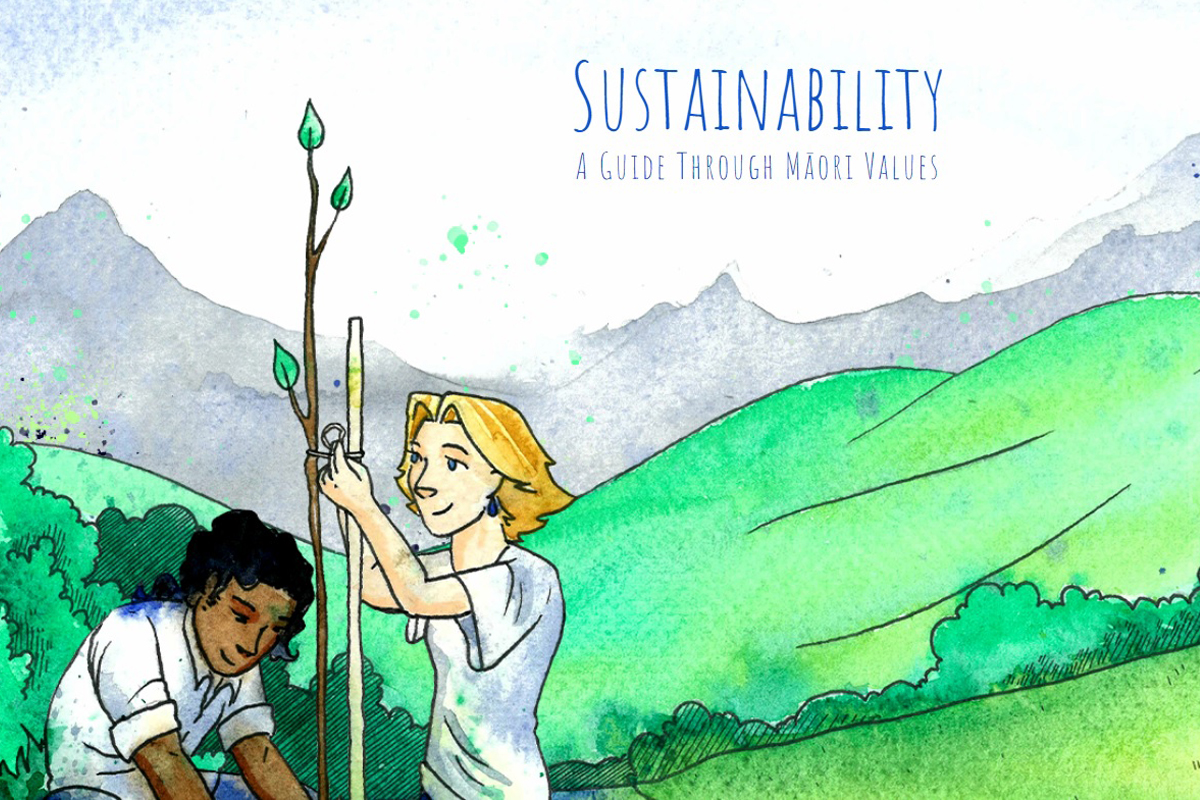
There are strong synergies between Māori values and western sustainability concepts. Many sustainability advocates also want to champion Māori culture, while utilising and growing Mātauranga Māori (Māori knowledge). Māori values are frequently acknowledged in sustainability work, but the practicalities of how to live those values in our everyday activities can still be challenging for many pakeha (non-Māori). The ‘Sustainability Guide Through Māori Values’ project was developed to provide a fun user-friendly resource to help the University community engage with Māori and understand how they can demonstrate through values through sustainable actions.
This project contributes to the University’s delivery of both Mai i te Iho ki te Pae (Māori Strategic Outcomes Framework) and Te Parahia (Sustainability Outcomes Framework).
The project was developed by way of the Summer Research Scholarship Programme and was ultimately a collaborative endeavour involving a student, academic staff, and University administrators. The project was managed through the co-supervision of Senior Lecturer in Sustainable Design, Tonya Sweet (School of Design Innovation) and VUW Director of Sustainability, Andrew Wilks. A talented third-year Design student, Jenny Gatehouse, was selected to develop the illustration and animation assets, as well as to build the website. Additional support on the project included oversight of the articulation of Māori values by Assistant Vice-Chancellor (Mātauranga Māori), Meegan Hall (Ngāti Ranginui & Ngāti Tūwharetoa) , guidance on the generation of imagery by Senior Lecturer in Māori Design, David Hakaraia (Ngāpuhi and Ngāti Paoa), and assistance by Senior Advisor for the Living Pā and PVC Māori, Rhonda Thomson (Poutini Ngāi Tahu). Collaborations across students, academic staff, and administration are a rare occurrence within the institution, and the co-design process pursued in the development of this project is in itself unique and resulted in a highly unique output.
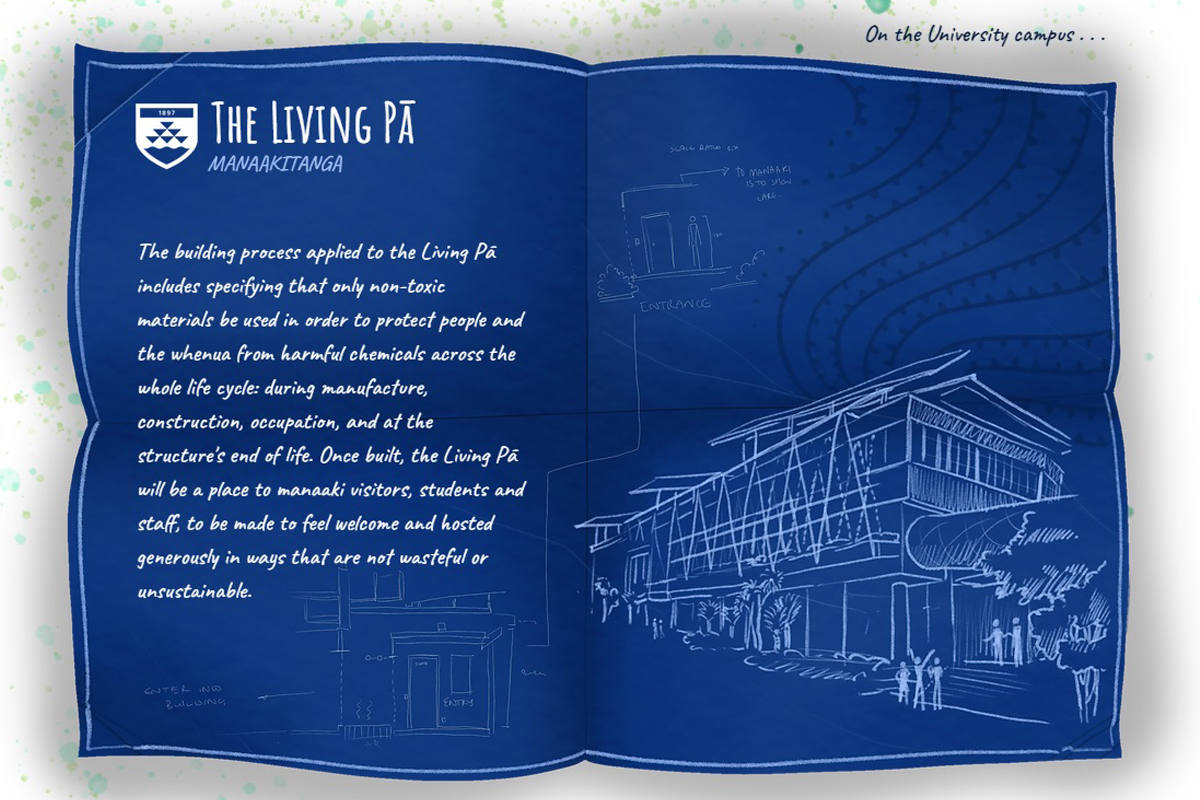
The final product of this collaboration – a user-friendly, multi-media website accessible via the University’s Sustainability homepage – illuminates seven Māori values according to their alignment with Western concepts of sustainability including: manaakitanga, whakapapa, whanaungatanga, mōhiotanga, kaitiakitanga, mauri, and whai mātauranga. The communication of these values is delivered according to a four-part structure that facilitates diverse pathways to understanding, engagement, and appreciation: (1) A definition of each value is provided to support comprehension; (2) A invitation for enagagement within the context of everyday life is offered under the heading, “Your part to play”; (3) An animation is provided to bring each invitation for engagement to life for the viewer; and, (4) Each value is highlighted as it is or will be applied to the University’s Living Pā project (a redevelopment of the University’s marae precinct, which is currently in construction and designed to meet Living Building Challenge certification). Taken as a comprehensive whole, the website enables an entrypoint for the University community and external visitors to expand their knowledge about sustainability within the context of Mātauranga Māori, explore opportunities to utilise these values in their personal lives, and celebrate the ways that the University is implementing these values on campus.
Since its publication in May 2023, the website has had hundreds of views, including visitors from within the University community as well as garnishing international access.
Environmental and social benefits
Four primary benefits have been identified resulting from this project:
- The website functions as an engaging educational tool that directly supports environmental and social sustainability goals.
- The unique approach applied to this educational tool invites and celebrates cultural engagement with broad concepts of sustainability.
- The accessibility of the website affords outreach to the whole University community and beyond for a wide (national) audience
- The project supported valuable learning outcomes for the design student involved, as well as supporting cross-disciplinary co-design engagement amongst various staff across the University.
Leadership and engagement
The distinctive attributes of this proposal include the following:
- The proposal reflects a unique approach to supporting comprehensive sustainability education. No other equivalent resource is currently available that provides a practical guide to integrate Māori values with sustainability concepts.
- The proposal leverages and highlights the synergistic ethos of the Living Pā project as an exemplar for how the institution is enacting the values introduced.
- The proposal showcases a bespoke and engaging multi-media web-tool that is the outcome of a robust cross-disciplinary co-design process.
- The proposal reflects the opportunities and challenges in navigating sensitive cultural nuances in communicating sustainability concepts through a Māori lens.
Significance to the sector
- No other Universities have provided a resource like this;
- Increasingly NZ Universities are emphasising the connection to Māori values in their sustainability work but the emphasis is more on strategy and governance, rather than practical guides.
Wider societal impact
Increasingly pakeha are looking for ways to become better Treaty partners as our society matures. While we still have a long way to go, this resource helps with cross-cultural communication and understanding, by de-mystifying Māori values.
This resource will increase understanding of Māori values amongst sustainability champions, while also increasing engagement with sustainability action among Māori – availing both angles increases the audience and impact.
Learner/Graduate employer impact
Cultural competencies are desired by employers, so the web-tool will be a valuable resource for students in developing these skills and knowledge areas. Furthermore, employers can reference the tool themselves as a point of information or as a reference in evaluating how their values align with sustainability.


Top 3 learnings
Supported by

Category finalists

Diversity, Equity & Inclusion in Sustainability
Diversity, Equity & Inclusion in Sustainability
Diversity, Equity & Inclusion in Sustainability/Winners
Diversity, Equity & Inclusion in Sustainability/Winners
Diversity, Equity & Inclusion in Sustainability category
There are strong synergies between Māori values and western sustainability concepts. Many sustainability advocates also want to champion Māori culture, while utilising and growing Mātauranga Māori (Māori knowledge). Māori values are frequently acknowledged in sustainability work, but the practicalities of how to live those values in our everyday activities can still be challenging for many pakeha (non-Māori). The ‘Sustainability Guide Through Māori Values’ project was developed to provide a fun user-friendly resource to help the University community engage with Māori and understand how they can demonstrate through values through sustainable actions.
This project contributes to the University’s delivery of both Mai i te Iho ki te Pae (Māori Strategic Outcomes Framework) and Te Parahia (Sustainability Outcomes Framework).
The project was developed by way of the Summer Research Scholarship Programme and was ultimately a collaborative endeavour involving a student, academic staff, and University administrators. The project was managed through the co-supervision of Senior Lecturer in Sustainable Design, Tonya Sweet (School of Design Innovation) and VUW Director of Sustainability, Andrew Wilks. A talented third-year Design student, Jenny Gatehouse, was selected to develop the illustration and animation assets, as well as to build the website. Additional support on the project included oversight of the articulation of Māori values by Assistant Vice-Chancellor (Mātauranga Māori), Meegan Hall (Ngāti Ranginui & Ngāti Tūwharetoa) , guidance on the generation of imagery by Senior Lecturer in Māori Design, David Hakaraia (Ngāpuhi and Ngāti Paoa), and assistance by Senior Advisor for the Living Pā and PVC Māori, Rhonda Thomson (Poutini Ngāi Tahu). Collaborations across students, academic staff, and administration are a rare occurrence within the institution, and the co-design process pursued in the development of this project is in itself unique and resulted in a highly unique output.
The final product of this collaboration – a user-friendly, multi-media website accessible via the University’s Sustainability homepage – illuminates seven Māori values according to their alignment with Western concepts of sustainability including: manaakitanga, whakapapa, whanaungatanga, mōhiotanga, kaitiakitanga, mauri, and whai mātauranga. The communication of these values is delivered according to a four-part structure that facilitates diverse pathways to understanding, engagement, and appreciation: (1) A definition of each value is provided to support comprehension; (2) A invitation for enagagement within the context of everyday life is offered under the heading, “Your part to play”; (3) An animation is provided to bring each invitation for engagement to life for the viewer; and, (4) Each value is highlighted as it is or will be applied to the University’s Living Pā project (a redevelopment of the University’s marae precinct, which is currently in construction and designed to meet Living Building Challenge certification). Taken as a comprehensive whole, the website enables an entrypoint for the University community and external visitors to expand their knowledge about sustainability within the context of Mātauranga Māori, explore opportunities to utilise these values in their personal lives, and celebrate the ways that the University is implementing these values on campus.
Since its publication in May 2023, the website has had hundreds of views, including visitors from within the University community as well as garnishing international access.
Top 3 learnings
Environmental and social benefits
Four primary benefits have been identified resulting from this project:
- The website functions as an engaging educational tool that directly supports environmental and social sustainability goals.
- The unique approach applied to this educational tool invites and celebrates cultural engagement with broad concepts of sustainability.
- The accessibility of the website affords outreach to the whole University community and beyond for a wide (national) audience
- The project supported valuable learning outcomes for the design student involved, as well as supporting cross-disciplinary co-design engagement amongst various staff across the University.
Leadership and engagement
The distinctive attributes of this proposal include the following:
- The proposal reflects a unique approach to supporting comprehensive sustainability education. No other equivalent resource is currently available that provides a practical guide to integrate Māori values with sustainability concepts.
- The proposal leverages and highlights the synergistic ethos of the Living Pā project as an exemplar for how the institution is enacting the values introduced.
- The proposal showcases a bespoke and engaging multi-media web-tool that is the outcome of a robust cross-disciplinary co-design process.
- The proposal reflects the opportunities and challenges in navigating sensitive cultural nuances in communicating sustainability concepts through a Māori lens.
Significance to the sector
- No other Universities have provided a resource like this;
- Increasingly NZ Universities are emphasising the connection to Māori values in their sustainability work but the emphasis is more on strategy and governance, rather than practical guides.
Wider societal impact
Increasingly pakeha are looking for ways to become better Treaty partners as our society matures. While we still have a long way to go, this resource helps with cross-cultural communication and understanding, by de-mystifying Māori values.
This resource will increase understanding of Māori values amongst sustainability champions, while also increasing engagement with sustainability action among Māori – availing both angles increases the audience and impact.
Learner/Graduate employer impact
Cultural competencies are desired by employers, so the web-tool will be a valuable resource for students in developing these skills and knowledge areas. Furthermore, employers can reference the tool themselves as a point of information or as a reference in evaluating how their values align with sustainability.
Supported by
Category finalists
Diversity, Equity & Inclusion in Sustainability
Diversity, Equity & Inclusion in Sustainability
Diversity, Equity & Inclusion in Sustainability/Winners
Diversity, Equity & Inclusion in Sustainability/Winners